
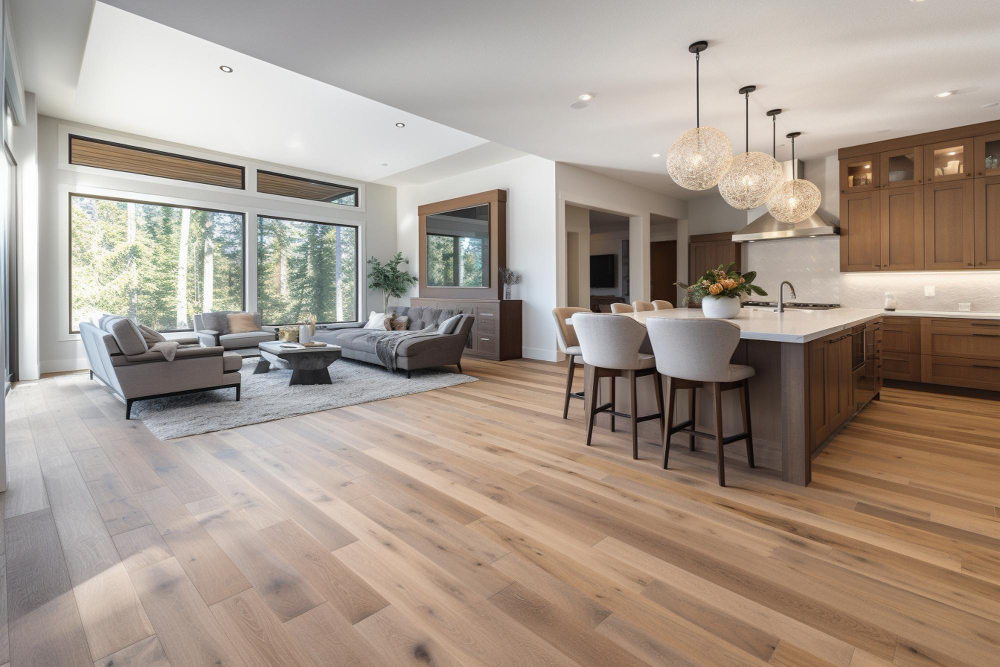
When homeowners plan a renovation, they often focus first on cabinetry, paint colors, or furniture. Yet one element quietly influences every room more than almost any other: the floor beneath your feet. Well-designed floors establish the visual foundation of a home, affect everyday comfort, determine maintenance requirements, and contribute significantly to long-term property value.
Unlike decorative updates that may change every few years, flooring is expected to perform for decades. It must withstand foot traffic, pets, furniture movement, moisture, sunlight, and daily wear while continuing to complement the home’s overall design. Because of this, choosing flooring should always be approached as both a design decision and a long-term investment.
- Flooring is one of the largest continuous surfaces inside a home.
- Material selection directly impacts durability, maintenance, indoor comfort, and resale appeal.
- A consistent flooring strategy can make rooms feel larger and create better visual flow throughout the home.
Understanding Today’s Flooring Options
Modern flooring materials offer far more variety than they did even a decade ago. Homeowners can now choose products specifically designed for moisture resistance, pet-friendly performance, low maintenance, or premium aesthetics.
| Flooring Type | Main Advantage | Best Application |
|---|---|---|
| Hardwood | Timeless appearance | Living rooms and bedrooms |
| Engineered Wood | Improved dimensional stability | Main living areas |
| Porcelain Tile | Excellent water resistance | Bathrooms and kitchens |
| Luxury Vinyl | Durability with easy maintenance | Busy family homes |
| Laminate | Affordable wood appearance | Low- to moderate-traffic spaces |
Every material has strengths and limitations. The ideal choice depends on lifestyle rather than appearance alone. Families with young children or pets often prioritize scratch resistance and easy cleaning, while homeowners seeking a premium architectural aesthetic may value natural materials despite their additional maintenance.
Another important consideration is moisture exposure. Rooms such as bathrooms, laundry areas, and kitchens require flooring capable of handling occasional spills and humidity without swelling or deteriorating.
Using flooring specifically designed for each room’s conditions can significantly extend the lifespan of the installation while reducing maintenance costs.
The Numbers Behind Long-Term Value
Flooring influences more than appearance. It affects cleaning time, indoor acoustics, thermal comfort, and future remodeling expenses. Investing in quality materials often lowers replacement frequency, making higher initial costs worthwhile over the life of the home.
| Evaluation Factor | Why It Matters |
|---|---|
| Durability | Handles everyday wear and heavy traffic. |
| Maintenance | Determines long-term cleaning effort. |
| Moisture Resistance | Protects against spills and humidity. |
| Comfort | Improves everyday living experience. |
| Visual Consistency | Creates better flow between rooms. |
Homeowners also benefit from planning flooring as part of a whole-house strategy rather than selecting materials room by room. Coordinated transitions, consistent color palettes, and compatible textures create a more cohesive interior while simplifying future updates.
- Higher-quality flooring generally lasts significantly longer than entry-level alternatives.
- Low-maintenance materials reduce annual upkeep and replacement costs.
- Durable flooring remains one of the most desirable features for prospective homebuyers.
Making an Informed Flooring Decision
Selecting flooring should begin with understanding how each room functions. High-traffic entryways demand different performance characteristics than quiet bedrooms, while kitchens and bathrooms require materials capable of resisting moisture and frequent cleaning.
Homeowners should also evaluate subfloor conditions before installation. An uneven or damaged subfloor can shorten the lifespan of even the highest-quality flooring products. Professional preparation helps prevent squeaks, movement, premature wear, and installation failures.
Sustainability has become another important factor in modern remodeling. Many manufacturers now produce flooring using recycled materials, responsibly sourced wood, and low-emission finishes that contribute to healthier indoor environments.
Finally, timeless design almost always outperforms short-lived trends. Neutral colors, natural textures, and durable finishes allow homeowners to refresh furniture and décor over time without needing to replace the flooring itself.
Well-planned floors do much more than complete a room. They create continuity throughout the home, improve daily comfort, support long-term durability, and provide a foundation that every other design decision can build upon. By balancing performance, maintenance, and aesthetics, homeowners can enjoy flooring that continues delivering value for many years after installation.