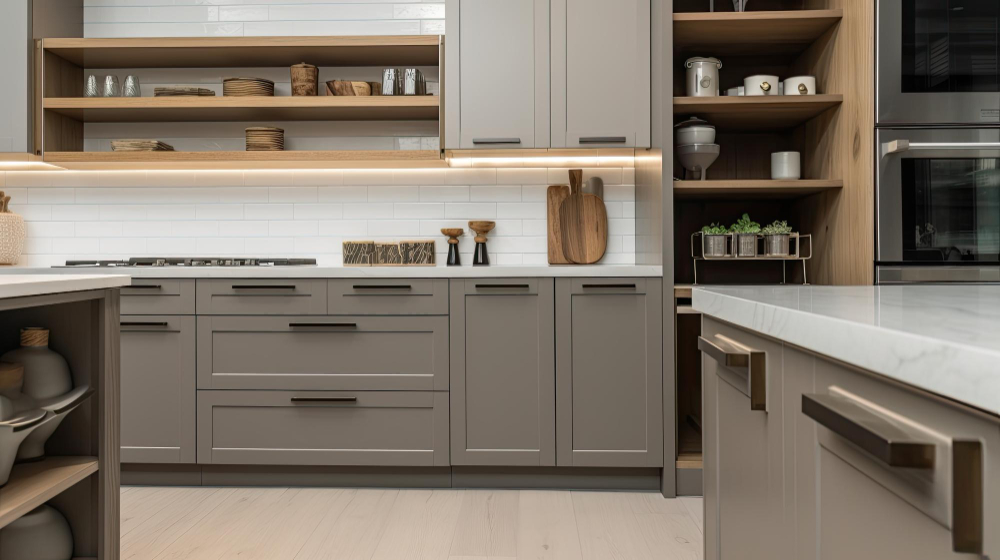
Choosing Kitchen Cabinets is not simply a matter of selecting a door color. Cabinets determine how much usable storage your kitchen provides, how efficiently you prepare meals, how often repairs are needed, and how much of your remodeling budget remains for countertops, appliances, plumbing, and lighting. The most common options—stock, semi-custom, and custom—can all work well, but they serve very different homeowners, budgets, and project goals.
What Separates the Three Cabinet Types?
Stock cabinets are mass-produced in standard dimensions, finishes, and configurations. Because manufacturers build them in large quantities, they are usually the fastest and least expensive option. However, limited sizing can create unused gaps, filler panels, or compromises in kitchens with unusual walls and dimensions.
Semi-custom cabinets begin with standardized cabinet boxes but allow more choices in width, depth, finish, hardware, storage accessories, and door style. They are often the strongest middle-ground choice for homeowners who want better functionality without paying for fully custom construction.
Custom cabinets are designed and built specifically for the room. They can accommodate sloped ceilings, out-of-square walls, uncommon appliance sizes, historic architecture, and highly personalized storage requirements. The tradeoff is a higher price and longer production schedule.
| Feature | Stock Cabinets | Semi-Custom Cabinets | Custom Cabinets |
|---|---|---|---|
| Typical Cost Level | Lowest | Moderate | Highest |
| Typical Lead Time | 1–4 weeks | 4–10 weeks | 8–16+ weeks |
| Size Flexibility | Limited | Good | Excellent |
| Finish Selection | Limited | Extensive | Nearly unlimited |
| Storage Personalization | Basic | Moderate to high | Fully personalized |
| Best For | Rentals and budget remodels | Most family kitchens | Luxury or complex layouts |
Option A: Stock Cabinets
Stock cabinets are best for kitchens with straightforward dimensions and homeowners who need to control costs. Most units are available in fixed widths, often increasing in three-inch increments. This means a 27-inch cabinet may be available while a 28-inch cabinet is not, forcing the installer to use filler strips or change the layout.
Pros
- Lower purchase price.
- Shorter ordering and delivery time.
- Simple replacement for standard kitchen layouts.
- Useful for rental homes, flips, and short-term ownership.
Cons
- Limited sizes may waste storage space.
- Interior accessories are often basic.
- Finish and door-style selections may be restricted.
- Entry-level boxes may use thinner particleboard or lightweight hardware.
Winner Highlight: Stock cabinets win when speed and budget matter more than personalization.
Option B: Semi-Custom Cabinets
Semi-custom cabinetry usually provides the best balance for homeowners planning to stay in the home for several years. Buyers can often modify cabinet widths, increase depth, add pantry pullouts, choose stronger drawer construction, and select from more finishes.
This category also allows homeowners to spend strategically. For example, you may choose standard cabinets around the perimeter while investing in specialized drawers, a better pantry system, or an upgraded island.
Pros
- More design flexibility than stock products.
- Better access to drawer organizers and storage accessories.
- Broader finish, hardware, and door selections.
- Strong value for long-term family kitchens.
Cons
- Longer lead times than stock cabinets.
- Upgrades can quickly increase the final cost.
- Not every unusual dimension can be accommodated.
Winner Highlight: Semi-custom cabinets are the best overall choice for many homeowners because they improve storage and design flexibility without reaching full custom pricing.
Option C: Custom Cabinets
Custom Kitchen Cabinets are made for the exact dimensions and requirements of the room. They are particularly valuable in older homes where floors, ceilings, and walls may not be perfectly level or square. A custom builder can also design around oversized appliances, narrow corners, ceiling beams, or architectural details that standard cabinet lines cannot address.
Pros
- Maximum use of available space.
- Cabinet dimensions can match the room precisely.
- Greater control over materials and construction methods.
- Ideal for luxury, historic, and highly specialized kitchens.
Cons
- Highest initial investment.
- Long production and installation timelines.
- Late design changes may be expensive.
- Accurate measurements and experienced installation are essential.
Winner Highlight: Custom cabinets win for unusual layouts, premium homes, and owners who expect to remain in the property long term.
Materials Matter More Than the Cabinet Label
The words “stock,” “semi-custom,” and “custom” describe how cabinets are ordered, but they do not automatically guarantee quality. A well-built stock cabinet may outperform a poorly constructed custom one.
| Component | Budget Option | Better Long-Term Option | What to Check |
|---|---|---|---|
| Cabinet Box | Particleboard | Plywood | Thickness and moisture resistance |
| Painted Door | Lower-grade fiberboard | Quality MDF or hardwood frame | Finish consistency and edge sealing |
| Drawer Box | Stapled construction | Dovetail construction | Joint strength and bottom thickness |
| Drawer Slides | Basic side-mount | Full-extension soft-close | Weight rating and smooth operation |
| Hinges | Standard close | Adjustable soft-close | Accessibility and replaceability |
Plywood cabinet boxes are generally more resistant to fastener movement and moisture than low-density particleboard. However, quality particleboard can still perform adequately in a dry, professionally installed kitchen. MDF is often an excellent material for painted cabinet doors because its smooth surface produces a consistent finish and resists some of the expansion lines that can appear on painted solid wood.
Hidden Costs Homeowners Frequently Miss
The cabinet quote is rarely the complete cabinet budget. Before comparing proposals, determine whether each estimate includes:
- Removal and disposal of existing cabinets.
- Delivery and handling charges.
- Installation labor.
- Decorative end panels and finished cabinet sides.
- Crown molding, toe kicks, and filler strips.
- Handles, pulls, hinges, and drawer slides.
- Interior organizers and pullout shelves.
- Electrical work for under-cabinet lighting.
- Wall repair, painting, or flooring adjustments.
A lower cabinet price can become more expensive after missing accessories and installation materials are added. Request an itemized proposal so you can compare equivalent scopes of work.
Where to Spend and Where to Save
Spend more on cabinet boxes, hinges, drawer slides, and frequently used storage. These components experience daily wear and are difficult to replace without disrupting the kitchen.
You can often save by limiting decorative glass doors, elaborate moldings, custom paint colors, and specialty accessories that do not improve your routine. Open shelving may look less expensive, but it requires frequent cleaning and reduces concealed storage, so it should be used selectively.
Professional Kitchen Cabinetry planning can also prevent wasted spending by matching cabinet features to your actual cooking and storage habits rather than filling the design with unnecessary upgrades.
Which Option Should You Choose?
| Your Situation | Recommended Choice | Why |
|---|---|---|
| Rental or investment property | Stock | Lower cost and faster replacement |
| First home with a limited budget | Stock or entry-level semi-custom | Controls costs while allowing selective upgrades |
| Growing family | Semi-custom | Better storage and durable everyday functionality |
| Historic or irregularly shaped kitchen | Custom | Fits unusual walls and architectural conditions |
| Long-term or luxury residence | Semi-custom or custom | Supports personalization and long service life |
Before ordering Kitchen Cabinets, finalize appliance sizes, confirm plumbing and electrical locations, inventory the items you need to store, and review the cabinet construction specifications—not only the door sample. For most homeowners, semi-custom cabinetry offers the strongest combination of quality, flexibility, and price. Stock cabinets remain a practical choice for simple kitchens and controlled budgets, while custom cabinets are justified when the room or homeowner requires a truly individualized solution.
Leave a Reply